In a recent piece for National Review (“Why I Will Never Be A Free Trader“) writer Michael Brendan Dougherty builds the core of his argument around the observation that “Free trade is not a principle; it is an expedient” – a line he attributes to an 1843 speech by British Tory politician Benjamin Disraeli.
There’s a problem with this quotation though. Disraeli never said it. The line does not appear in the associated parliamentary record for his speech (HC Deb 25 April 1843 vol 68 cc902-71), nor is it anywhere to be found in the collected speeches of Disraeli.
The quip is a misquotation that first appeared in Samuel Arthur Bent’s 1882 book Short Sayings By Great Men.
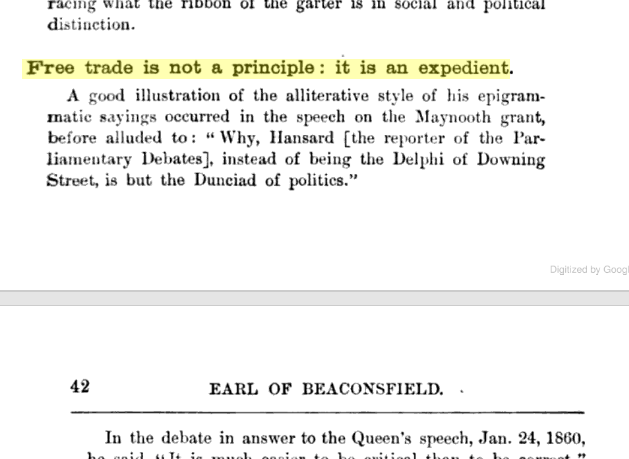
The authentic quote by Disraeli, which Dougherty later references, made the opposite claim: “Protection is not a principle, but an expedient.” Unmentioned by Dougherty though, the context of this passage reveals an ugly side of Disraeli’s political career.
The genuine passage comes from Disraeli’s speech on March 17, 1845, opposing the repeal of Britain’s protectionist Corn Laws, or tariffs on imported food. These measures drove up the price of British-grown crops to the benefit of wealthy landowners – a prominent constituency of the Tory party. They also contributed to a humanitarian catastrophe in 1845 when the potato blight hit Ireland. The ensuing famine induced Tory Prime Minister Sir Robert Peel to break with his party and ally with the free trade opposition, thereby repealing the Corn Laws in 1846. Disraeli’s embrace of protectionist tariff “expedience” on the part of landowning special interests came at the direct expense of the Irish famine’s victims. This is hardly a legacy that tariff enthusiasts, conservatives, or anyone for that matter should celebrate.